
Beyond Traditional Luxury Services
When many people hear the term “concierge service,” they immediately think about luxury hotels, restaurant reservations, or lifestyle management for wealthy individuals. While those associations exist, modern concierge structures have evolved far beyond traditional hospitality services. For international entrepreneurs, consultants, investors, and globally mobile professionals, the real value of a concierge service lies in operational coordination and organizational support.
International business today creates administrative complexity on many levels. Travel planning, communication across jurisdictions, payment coordination, documentation, scheduling, service providers, banking relationships, relocation processes, and international infrastructure all require continuous management. Over time, these tasks consume a significant amount of executive attention and reduce operational efficiency.
A modern concierge service acts as an organizational coordination layer. Its purpose is not only convenience, but continuity and structure.
Executive Coordination Instead of Lifestyle Marketing
Many public-facing concierge services focus heavily on luxury branding and emotional marketing. However, entrepreneurs operating internationally often need something different. They require reliability, discretion, organization, and continuity.
Modern executive concierge services increasingly function as administrative support structures that coordinate multiple processes simultaneously. This may include communication management, travel coordination, document preparation, scheduling, international service provider coordination, organizational follow-up, or operational assistance during relocation or international expansion.
The objective is not dependency, but operational simplification.
The Importance of Long-Term Organization
International entrepreneurs often build fragmented systems over time. Different travel providers, separate communication channels, disconnected documentation, and inconsistent organizational processes create operational stress. A structured concierge system centralizes these areas into a coordinated framework.
This becomes increasingly important when operating across multiple countries, currencies, or regulatory environments. Administrative continuity and organizational oversight become strategic advantages.
Confidentiality and Trust
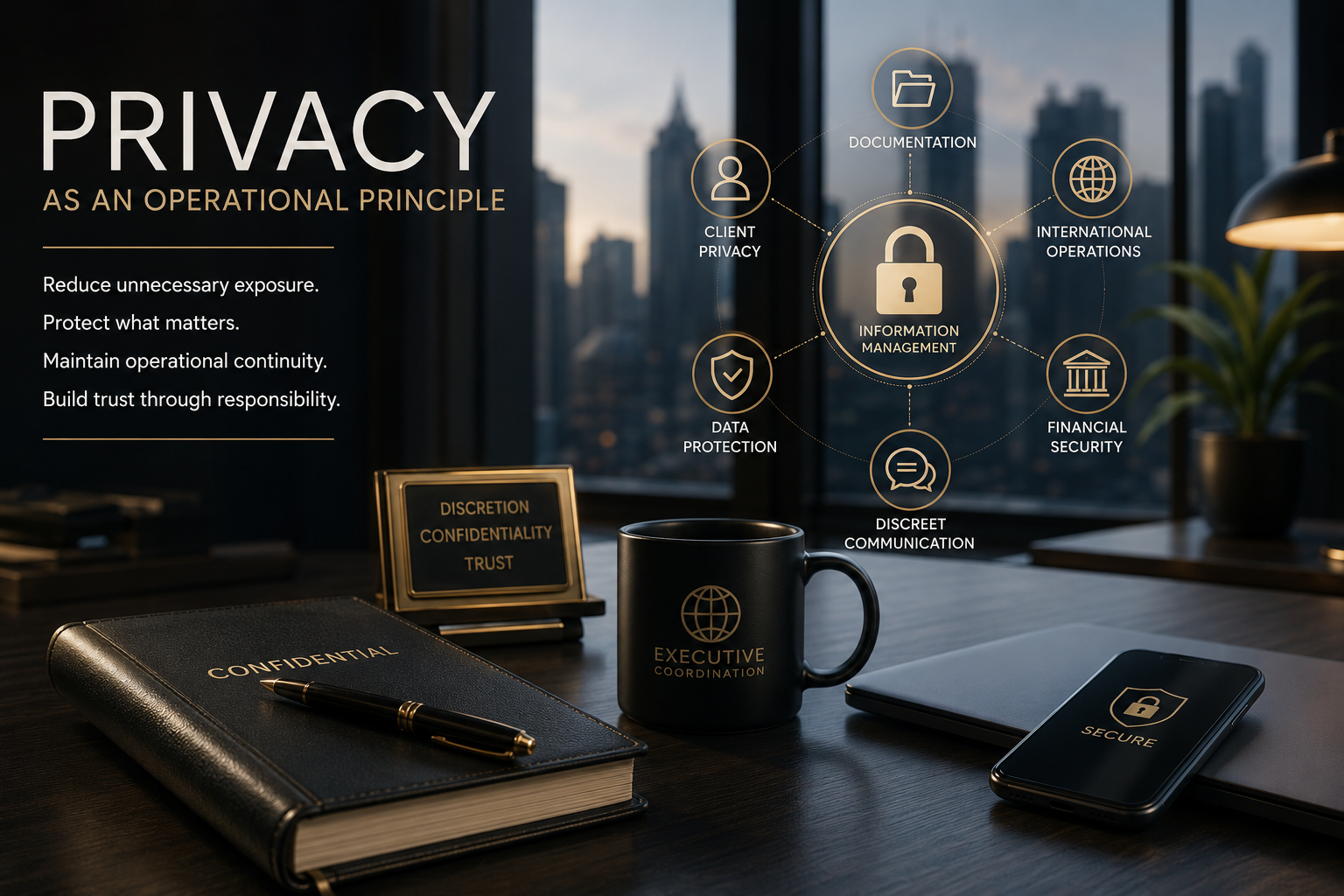
For many clients, discretion is as important as efficiency. International coordination often involves sensitive operational information, travel schedules, communication data, or organizational planning. As a result, confidentiality and professional handling of information become fundamental principles of executive support.
Modern concierge services therefore increasingly resemble private operational coordination offices rather than traditional hospitality services.